Dubai Storm, a Wake-up Call for a Climate-resilient Infrastructure
Written by: Abimanyu A. Atmaja, Cecilia N. Yuanita, Dekka D. Putra, Kharis A. Alam
Edited by: Chelsea Patricia
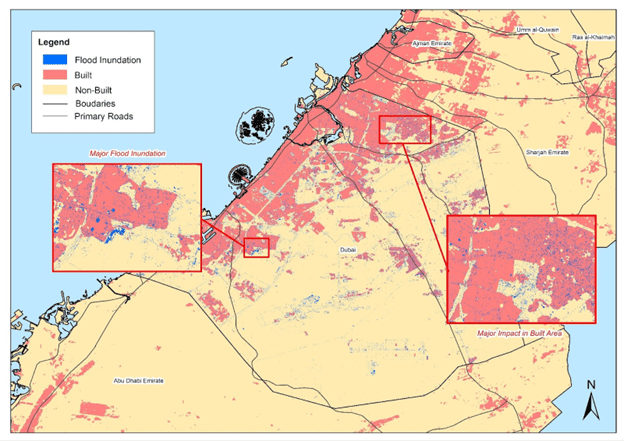
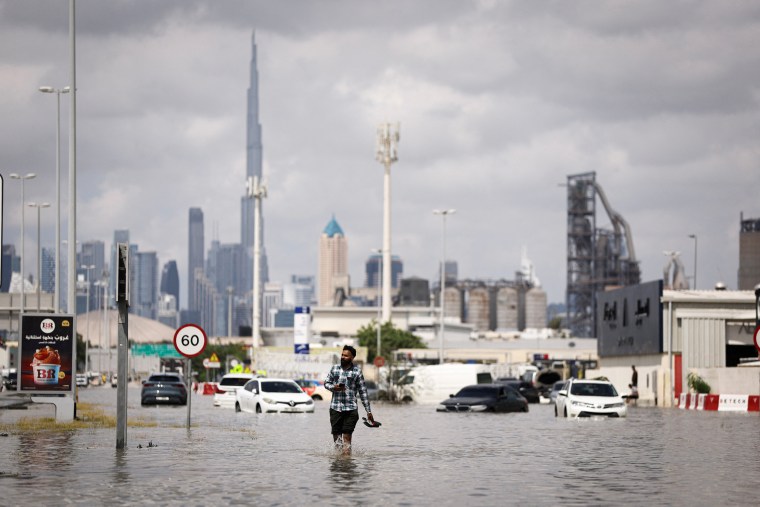 In mid-April 2024, the UAE and parts of the Arabian peninsula experienced their heaviest rainfall in over seven decades. The torrential storm triggered widespread flooding, cutting off power, disrupting international transportation, and submerging highways. Based on an analysis of the Sentinel-1 SAR, the flood encompassed 170.98 km2 of Dubai areas, as seen in Figure 1. The latest report suggests up to 20 fatalities from this incident, all of which come from Oman’s residents. This event prompted several unanswered questions: Is cloud seeding the culprit behind this wild weather swing, or is something bigger at play?
In mid-April 2024, the UAE and parts of the Arabian peninsula experienced their heaviest rainfall in over seven decades. The torrential storm triggered widespread flooding, cutting off power, disrupting international transportation, and submerging highways. Based on an analysis of the Sentinel-1 SAR, the flood encompassed 170.98 km2 of Dubai areas, as seen in Figure 1. The latest report suggests up to 20 fatalities from this incident, all of which come from Oman’s residents. This event prompted several unanswered questions: Is cloud seeding the culprit behind this wild weather swing, or is something bigger at play?
Figure 1. The impacted area Source: RDI Staff Analysis on Landcover ESRI, Sentinel-1 SAR, Open Street Map, 2024
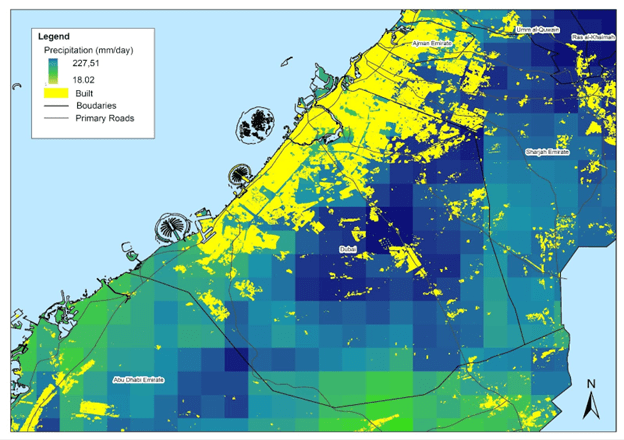
Manipulating the weather Cloud seeding operation has sparked public speculation regarding this extreme weather event. However, while cloud seeding, the practice of introducing chemicals to enhance precipitation, is employed in water-scarce regions like Dubai, a researcher linked to the city's effort has denied any activity during the downpour's lead-up. Even if implemented, cloud seeding is unlikely to increase Dubai's annual rain intensity (currently 140-200 mm/year) by more than 10-30%. Considering the significantly higher observed precipitation (227.51 mm/day, Figure 2) compared to the expected value, the intensification of the rainfall can be most plausibly due to the influence of climate change.
Figure 2. Precipitation rate on April 16th, 2024 Source: RDI Staff Analysis on CHIRPS Daily, Open Street Map, 2024
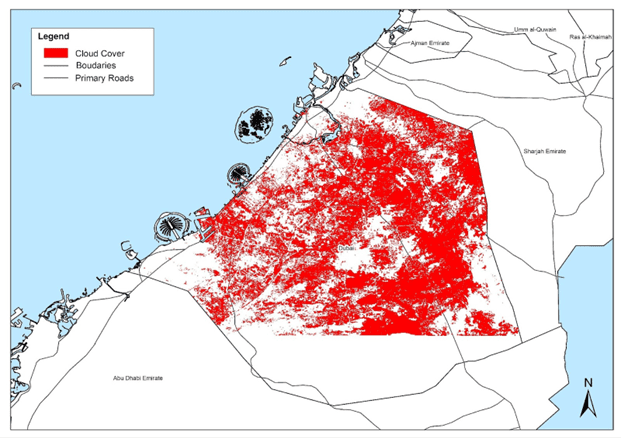
Generally speaking, this storm's occurrence was consistent with a typical weather system, in which variations in temperature and pressure between the Earth's surface and the upper atmosphere instigated the development of a storm. Nevertheless, with the gradual increase in surface temperatures over time caused by uncontrolled greenhouse gas emissions, the temperature differential between the surface and upper atmosphere amplifies, resulting in the heightened intensity of cloud and storm formation, as seen in Figure 3.
Figure 3. The clouds above Dubai before the extreme rainfall (April 16th, 2024) Source: RDI Staff Analysis on Copernicus/S2 Cloud Probability, Open Street Map, 2024
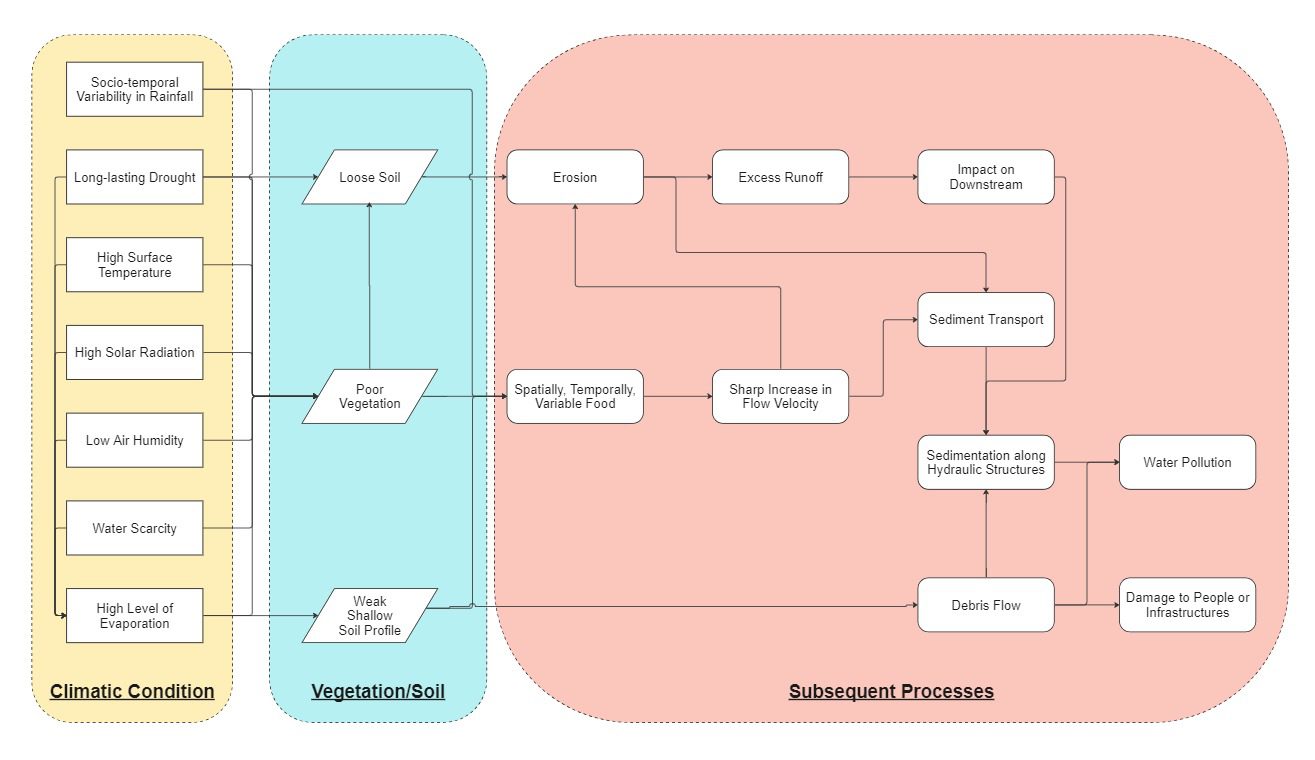
The World’s most resilient city faced an unprecedented threat Looking back a few years, the United Nations Office for Disaster Risk Reduction (UNDRR) has established Dubai as a global role model for smart, sustainable, and resilient cities. Dubai earned this status through innovative regulatory and urban development approaches to current international issues, particularly climate change. Unfortunately, the rapid escalation of climate change triggering massive rainfall in Dubai surpasses the infrastructure's capacity, highlighting the city's urgent need to enhance its ability to manage natural hazards. Dubai's rapid population growth has spurred significant development of built-up areas, encompassing settlement and transportation necessities, like flyovers, highways, and multi-story parking spaces. All of the mentioned infrastructures are characterised by a dominance of hard surfaces, contributing to increased surface runoff and a decline in natural infiltration. This impeded infiltration led to rainwater ponding on the surface rather than infiltrating the soil profile, as seen during the latest extreme storm. Aside from the flood risk management challenges posed by population growth and urban development, rainfall in arid areas, including the UAE, has increased significantly in recent years. The UAE's July 2022 event exemplifies this when the 2-days flooding affected the cities of Kalba and Fujairah. Learning the hard way The escalating threat of climate change in the arid and semi-arid areas exposed several aspects worth noting for city development, mainly related to flood risk management. Figure 4 highlights the cause-and-effect relation between unique regional traits and flood characteristics in the related regions.
Figure 4. Arid and semi-arid regional traits and flood characteristics’ cause-and-effect relation Source: Shima and Schüttrumpf, 2023
The government of Dubai Municipality demonstrated several ways to mitigate the natural threat posed by climate change despite its failure to comprehend the latest extreme weather events, for example, smart drainage systems, weather forecasting simulation models, and GIS and remote sensing for timely emergency warnings and responses. Nevertheless, to achieve a more resilient future while also coping with the area’s unique risks of drought and flood, several things can be put into consideration, including:- Addressing integrated water resource management and sustainable drainage
- Balancing the proportion of hard and soft surface installation
- Utilising suitable soil profile in landscape provision
- Enhancing community awareness in flood risk management
- Jung, Woonseon, Joo Wan Cha, A.-Reum Ko, Sanghee Chae, Yonghun Ro, Hyun Jun Hwang, Bu-Yo Kim, Jung Mo Ku, Ki-Ho Chang, and Chulkyu Lee. 2022. “Progressive and Prospective Technology for Cloud Seeding Experiment by Unmanned Aerial Vehicle and Atmospheric Research Aircraft in Korea.” Advances in Meteorology 2022. https://doi.org/10.1155/2022/3128657.
- Sherif, Mohsen, Mohamed Almulla, Ampar Shetty, and Rezaul K. Chowdhury. 2013. “Analysis of Rainfall, PMP and Drought in the United Arab Emirates.” International Journal of Climatology 34 (4): 1318–28. https://doi.org/10.1002/joc.3768.
- Chiu, Chien-Liang, I-Fan Hsiao, and Lily Chang. 2023. “Overviewing Global Surface Temperature Changes Regarding CO2 Emission, Population Density, and Energy Consumption in the Industry: Policy Suggestions.” Sustainability 15 (8): 7013–13. https://doi.org/10.3390/su15087013.
- UNDRR - Regional Office for Arab States. 2020. Dubai as a smart, sustainable and resilient role model city to establish a city resilience hub under the MCR 2030 Programme. https://www.undrr.org/news/dubai-smart-sustainable-and-resilient-role-model-city-establish-city-resilience-hub-under-mcr
- Elessawy, Fayez M. 2017. “The Boom: Population and Urban Growth of Dubai City.” Horizons in Humanities and Social Sciences: An International Refereed Journal 2 (2). https://doi.org/10.19089/hhss.v2i2.60.
- Nabinejad, Shima, and Holger Schüttrumpf. 2023. “Flood Risk Management in Arid and Semi-Arid Areas: A Comprehensive Review of Challenges, Needs, and Opportunities.” Water 15 (17): 3113. https://doi.org/10.3390/w15173113
- Abdelrazik, Hossam., and Naggar, Hadeel El. 2024. “Assessing community awareness for flood disaster in the UAE through human-centered design” IJDRR 107 (2024) 104475. https://doi.org/10.1016/j.ijdrr.2024.104475