
MediaMulti-Hazard Preparedness
Recent Post
Unlocking Global Market Access Through InTex Indonesia
Keynote Speech from Rizky Aditya Wijaya (Director of Textile, Leather, and Footwear Industry, Ministry of Industry)
Opening session from Nurlia Listiani (Associate Researcher at the Center for Behavioral and Circular Economy Research (PREPS), BRIN/InTex Indonesia)
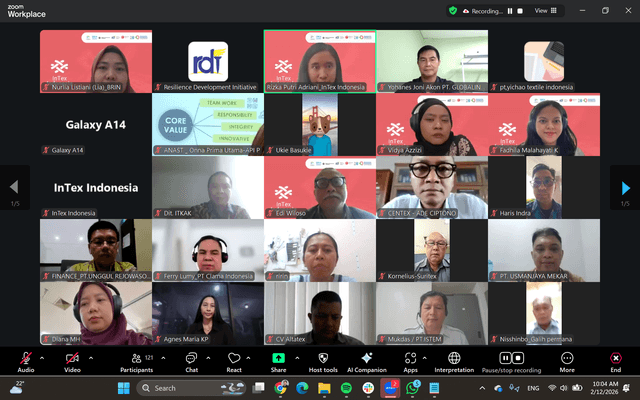
12 February 2026 — The webinar “Unlocking Global Market Access Through InTex Indonesia” brought together policymakers, industry leaders, and international partners to discuss how Indonesia’s textile sector can strengthen its competitiveness in the global market through sustainability and circularity which training is provided by InTex Indonesia. This webinar is hosted by the InTex Indonesia Consortium (RDI, BRIN, and James Cook University) in collaboration with the Ministry of Industry. The session was opened by Master of Ceremony, Rizka Adriani Putri (REER Research Analyst), followed by a keynote from Rizky Aditya Wijaya (Director of Textile, Leather, and Footwear Industry, Ministry of Industry), who emphasized that Indonesia’s textile industry must align with green industrial transformation, international standards, and long-term competitiveness strategies. The session was moderated by Nurlia Listiani (Associate Researcher at the Center for Behavioral and Circular Economy Research (PREPS), BRIN/InTex Indonesia), guiding discussions throughout the event.
Dr. Nizhar Marizi (Director of Environment, Ministry of National Development Planning (Bappenas)) presented regarding textile sector position within Indonesia’s Long-Term Low Emission Development Strategy (RAN-ES 2025–2045)
Muhamad Abdul Aziz (First Expert Industrial Advisor, Green Industry Center, Ministry of Industry of the Republic of Indonesia), who presented policy directions for green industry development and green financing
In the first segment, speakers outlined Indonesia’s national strategic direction. Dr. Nizhar Marizi (Director of Environment, Ministry of National Development Planning (Bappenas)) explained how the textile sector is positioned within Indonesia’s Long-Term Low Emission Development Strategy (RAN-ES 2025–2045), highlighting its importance in the country’s sustainable economic transition. This was followed by Muhamad Abdul Aziz (First Expert Industrial Advisor, Green Industry Center, Ministry of Industry of the Republic of Indonesia), who presented policy directions for green industry development and green financing, emphasizing that sustainability policies are increasingly tied to industrial growth and international trade readiness.
Carsten Sorensen (Head of Trade and Economic Section, Delegation of the European Union to Indonesia) highlighted the IEU-CEPA agreement as a strategic opportunity
Jemmie Cahyadi (Regulatory Committee Member, Indonesian Textile Association (API)), who discussed industry readiness to meet international sustainability standards.
Vidya Azzizi (Program Specialist, Resilience Development Initiative (RDI)) then presented how the program supports companies in adopting circular practices.
The second segment focused on economic opportunities and global market access. Carsten Sorensen (Head of Trade and Economic Section, Delegation of the European Union to Indonesia) highlighted the IEU-CEPA agreement as a strategic opportunity, noting that environmental compliance could unlock tariff reductions and expand export access to the European market. This perspective was reinforced by Jemmie Cahyadi (Regulatory Committee Member, Indonesian Textile Association (API)), who discussed industry readiness to meet international sustainability standards. The UNEP InTex Indonesia team represented by Vidya Azzizi (Program Specialist, Resilience Development Initiative (RDI)) then presented how InTex Indonesia supports companies in adopting circular practices, improving environmental data, and strengthening product credibility for international buyers. Participants from textile companies actively engaged in this session, raising questions on compliance pathways, financing readiness, and practical implementation challenges.
Indra Purba (Factory Manager, PT. Superbtex) shared operational insights on implementing sustainability and circular practices at factory level.
Devi Kusumaningtyas (Director of Government and Public Affairs for Indonesia, Philippines, and Malaysia, Nike) then highlighted how environmental compliance has become a competitive advantage for producers seeking to enter global supply chains.
The discussion became more practical during the industry sharing session. Indra Purba (Factory Manager, PT Superbtex) shared operational insights on implementing sustainability and circular practices at factory level, including process adjustments and business challenges. Devi Kusumaningtyas (Director of Government and Public Affairs for Indonesia, Philippines, and Malaysia, Nike) then highlighted how environmental compliance has become a competitive advantage for producers seeking to enter global supply chains. The session sparked further discussion, with several industry representatives contributing questions and reflections on how Indonesian manufacturers can accelerate their transition while maintaining productivity and market positioning.
Q & A Session with Webinar Attendee
Closing Remarks fromNico Barlev Marhehe (Programme Management Officer, United Nations Environment Programme (UNEP))
The webinar concluded with a call to action from the UNEP InTex Indonesia team, inviting companies to join the InTex program as a first step toward strengthening sustainability performance and expanding global market access. Closing remarks were delivered by Nico Barlev Marhehe (Programme Management Officer, United Nations Environment Programme (UNEP)), who emphasized that collaboration between government, industry, and international partners will be key to accelerating Indonesia’s transition toward a competitive and circular textile sector.
February 11th 2026
Subscribe to our Newsletter
Details
Related Khubs
Multi-Hazard Preparedness